Renovating in New York City is rarely delayed for just one reason. In most cases, timelines shift because so many moving parts are involved at the same time, including approvals, buildings, insurance, trades, materials, and ongoing decision-making throughout the project.
In NYC renovations, delays often increase when multiple vendors and contractors are managed separately rather than through one coordinated team overseeing the full process. This can create communication gaps, scheduling conflicts, approval delays, and missed details throughout the renovation process.
At NYTDR, we operate as an all-in-one restoration and renovation company, managing everything under one roof from insurance coordination through full construction completion. This helps streamline communication and reduces the need for homeowners to coordinate with multiple parties throughout the project.
Here’s what commonly causes renovation timelines to shift throughout NYC projects.
1. Insurance Scope and Approvals
For renovation projects that follow water, fire, or structural damage, insurance is often part of the process.
Delays typically happen when:
- The scope of work is interpreted differently between the insurer and contractor
- Documentation is incomplete or requires revisions
- Approvals move between multiple parties before being finalized
Even when physical work could begin, projects often pause while the insurance scope is clarified and aligned with actual construction requirements.
This early-stage misalignment is one of the most common sources of timeline disruption in restoration-related projects.
2. DOB Filings and Approval Cycles
In NYC, renovation work is tightly regulated through the Department of Buildings.
Even with complete drawings, approvals move through structured review cycles that can include:
- Examiner comments requiring revisions
- Multiple rounds of plan submissions
- Filing classification clarifications
A project is often “ready” on paper long before it is approved in practice.
That gap between readiness and approval is a major contributor to early project delays throughout New York City renovations.
3. Co-op and Condo Board Requirements
For many NYC apartments, especially co-ops and condos, building approval is another essential layer in the process.
Delays often come from:
- Alteration agreement review timelines
- Board meeting schedules which are often monthly
- Insurance and compliance documentation requirements
- Additional conditions imposed by building management
Even when all documents are submitted correctly, timing is dictated by the building’s internal schedule — not the project schedule.
In some cases, this alone can shift a start date by several weeks.
4. Trade Coordination and Sequencing Issues
Renovation work depends heavily on sequencing.
One trade must finish before the next can begin:
- Plumbing and electrical before walls are closed
- Inspections before finishing work
- Flooring before cabinetry installation in many cases
Delays occur when trades are not tightly coordinated or when one trade runs behind schedule, causing a ripple effect across the entire project.
In NYC, where multiple projects run simultaneously across the city, scheduling gaps between phases are common.
5. Material Lead Times and Availability
Material selection and procurement are another major delay factor.
Common issues include:
- Custom cabinetry or millwork production timelines
- Imported tile or stone shipping delays
- Fixture backorders or substitutions
- Late-stage design changes requiring reorders
A single delayed item can hold up multiple phases of work if it sits on the critical path of the project.
This is especially common in kitchens and bathrooms, where multiple systems and finish materials depend on one another to move forward.
6. Building Access and Working Restrictions
NYC buildings often have strict rules that directly affect construction timelines.
Many co-ops, condos, and residential buildings limit working hours to certain weekdays and times, reducing how many hours crews can work each day.
Construction schedules can also be affected by:
- Elevator reservation systems for material deliveries, debris removal, and contractor access
- Noise restrictions
- Required protection for hallways, elevators, and common areas
While these rules are standard throughout New York City, they still impact how quickly work can move on site. Even well-planned renovation schedules can shift depending on building access and availability.
7. Unexpected Conditions Behind Walls
One of the most unpredictable delay factors is what gets uncovered once demolition begins.
In older NYC buildings, it is common to find:
- Outdated electrical or plumbing systems
- Previous unpermitted work
- Structural irregularities
- Hidden water damage or mold behind finishes
These discoveries require immediate evaluation and sometimes redesign before work can continue safely and compliantly.
While these issues are not unusual, they do impact timelines because they are not visible until work begins.
8. Decision Delays During Construction
In NYC renovations, delays can happen when finish selections, materials, or key design decisions are not finalized at the stage they are needed while work on site is ready to move forward.
In some cases, unexpected field conditions may also require quick decisions before the next phase can continue.
Even short pauses in decision-making can affect multiple stages of a project. Because trades are scheduled in sequence, one delayed decision can push back several downstream phases already planned to follow.
This is one of the most overlooked reasons renovation timelines extend in NYC, as the impact of a small delay often becomes visible only after it affects multiple parts of the schedule.
At NYTDR, we guide homeowners through these decisions early in the process, helping them select materials and finishes that fit both the space and the overall project timeline to reduce unnecessary delays during construction.
How To Help Avoid Renovation Delays in NYC
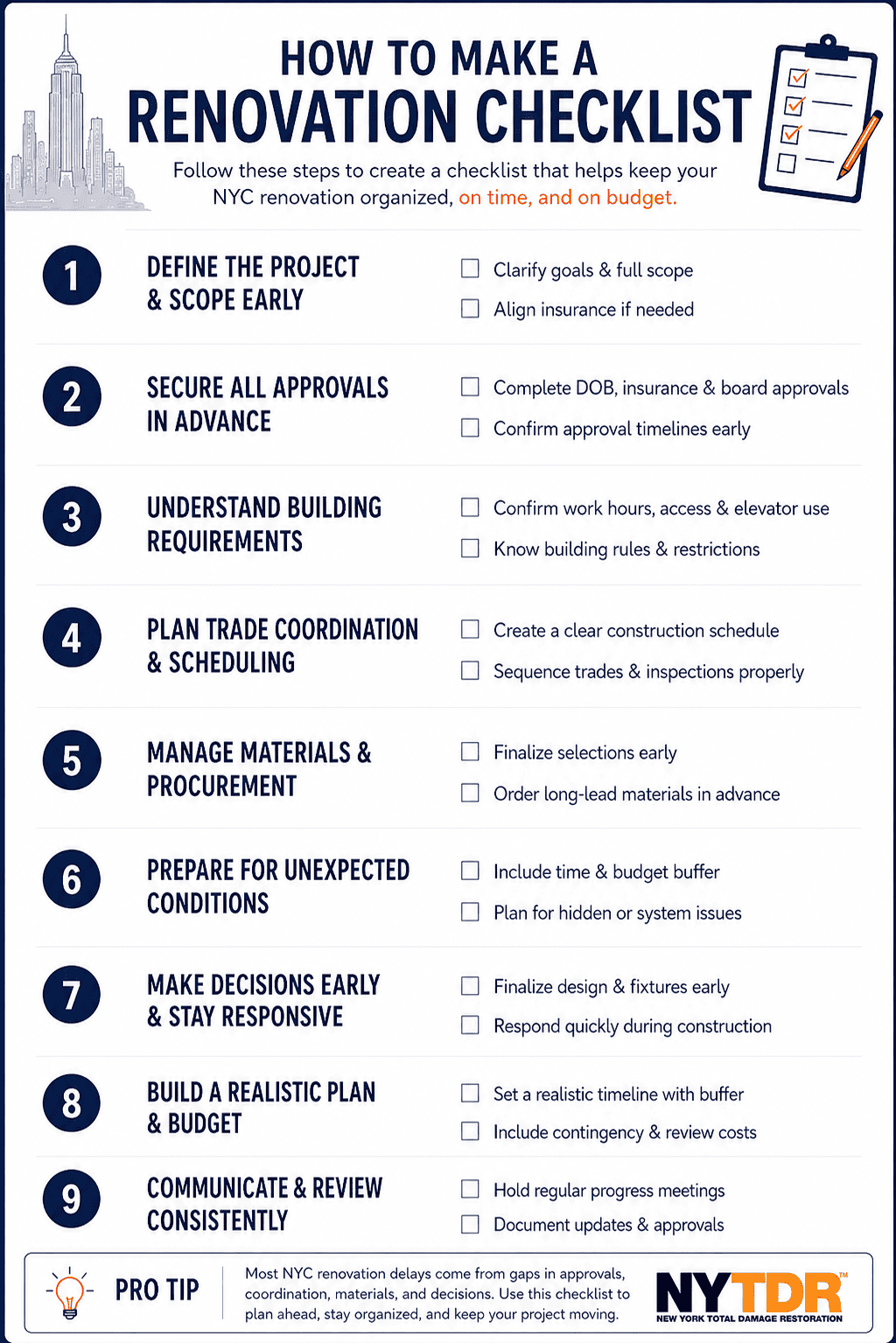
While some delays are unavoidable in NYC renovations, many can be reduced with the right planning and coordination.
- Finalize design, materials, and finish selections early before construction begins or reaches that stage
- Understand and secure all building requirements in advance, including approvals, insurance, and access rules
- Coordinate all trades and vendors through a clear schedule to avoid gaps, overlaps, and miscommunication
- Order long-lead materials early to prevent supply-related delays
- Make decisions quickly when unexpected conditions arise during construction
Even with strong planning, some delays can still occur in NYC renovations, but these steps help keep projects moving more efficiently.
Our Commitment at NYTDR
We manage restoration and renovation projects end-to-end, from insurance coordination through full construction completion, keeping everything under one roof.
This allows us to improve communication, scheduling and execution with the aim of keeping projects moving forward as smoothly, efficiently, and predictably as possible.
What Our Clients Say About Timelines and Budgets
⭐⭐⭐⭐⭐
When I was at my wit’s end after a catastrophic flood from the apartment upstairs destroyed my studio, I found a wonderful team in Perry, Michael, and Rojda. Perry was my biggest champion against the insurance company to make sure the renovation job was done right, and Michael was the absolute prince of execution. Timelines were realistic, and actually finished ON SCHEDULE and ON BUDGET, which was an amazing feat in itself. Rojda kept me informed / looped in throughout the entire project, and I felt very assured that I was receiving top notch service, quality, and incredible value for what was paid. I had complete faith in my team, and highly recommend NYTDR to anyone needing a dynamo team to achieve their vision for their space.
⭐⭐⭐⭐⭐
…This was a relatively big job, and they were good when the unexpected happened, like the discovery of mold. They lined up remediation right away and did a good job keeping to the schedule as closely as possible…
Final Thought
Most NYC renovation delays are not caused by one big issue.
They are caused by many small gaps between systems that are not working together.
When those systems are coordinated under one experienced team, the project becomes far more predictable, not because NYC becomes simpler, but because the process becomes more controlled and organized.
That is what helps keep projects moving on time and on budget.
Contact your Local Restoration Experts
Common Questions NYC Homeowners Ask Us
What do homeowners underestimate about renovations in NYC?
Many homeowners underestimate how long approvals can take, how disruptive renovations can become, and how often unexpected issues appear once work begins, especially in older NYC apartments, co-ops, and brownstones.
What unexpected problems can slow renovation work down?
Hidden plumbing leaks, outdated electrical systems, uneven flooring, mold, structural deterioration, and previous poor-quality work are frequently discovered during demolition and can extend renovation timelines.
What usually causes renovation timelines to change?
Mid-project design changes, material backorders, additional repair work, inspection scheduling, and building restrictions are some of the most common reasons renovation timelines shift during construction.
What do NYC co-ops and condos typically require before renovations begin?
Many NYC buildings require alteration agreements, proof of insurance, licensed contractors, approved work hours, elevator protection, debris-removal procedures, and advance notice before construction starts.
What homeowner mistakes can delay renovation projects?
Late material selections, changing plans during construction, hiring unlicensed contractors, and starting work without fully understanding building requirements can significantly delay renovation timelines.
What helps renovation projects stay on schedule?
Clear planning, early material ordering, realistic timelines, quick decision-making, experienced project coordination, and understanding building requirements before work begins all help renovation projects move more efficiently.